

The Hidden Payroll Structure That Turns Your Spouse Into a $25K Annual Tax Deduction
A 1954 Code provision, a landmark 10th Circuit ruling, and the only legal way most self-employed entrepreneurs can deduct 100% of family medical costs as a Schedule C business expense


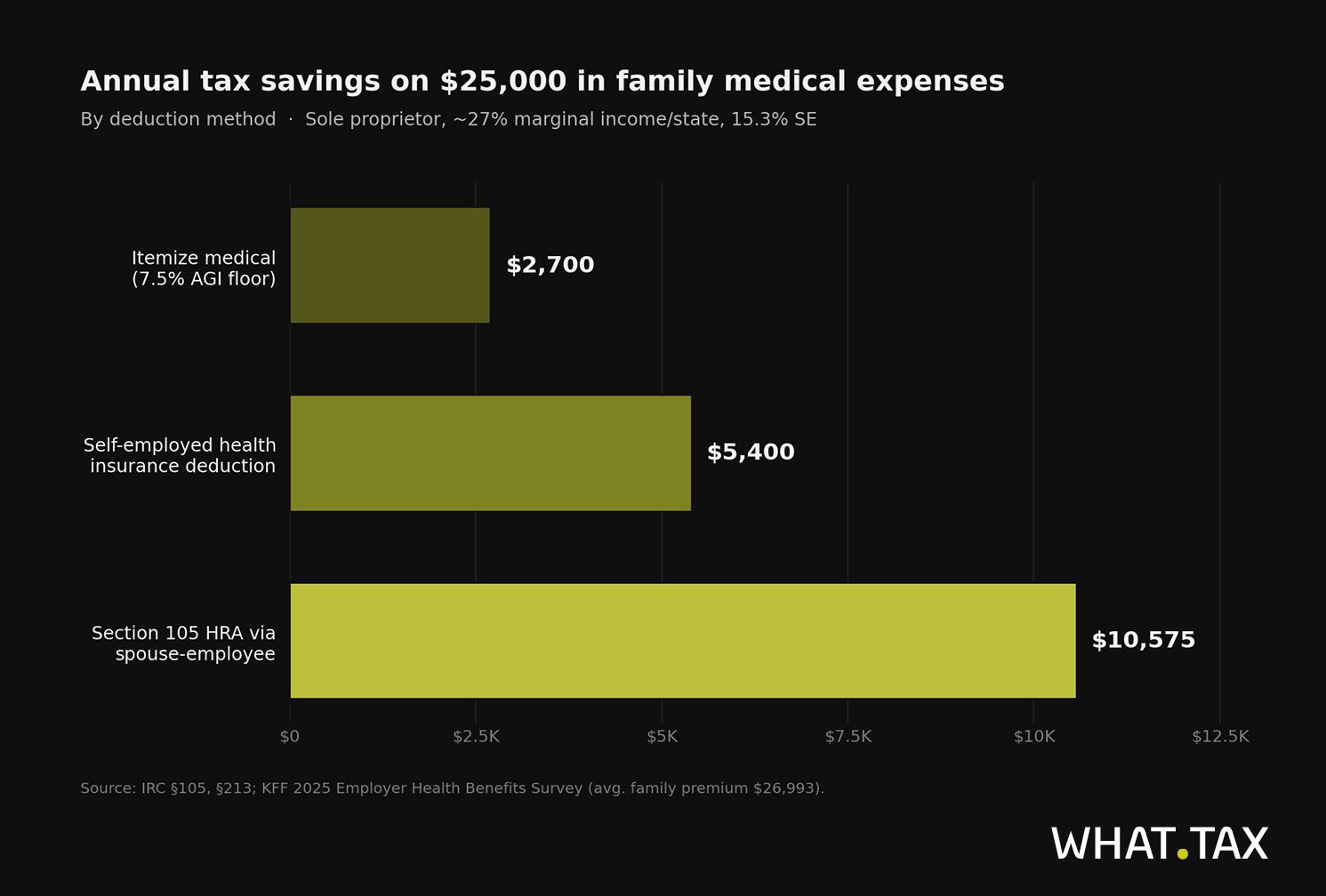
In 2025, the average U.S. family health insurance premium hit $26,993, according to the KFF Employer Health Benefits Survey. For a sole proprietor without a properly structured plan, that entire number is functionally a personal expense. The self-employed health insurance deduction softens the income-tax blow on the premium itself, but it does nothing for the 15.3% self-employment tax. It does nothing for the $4,550 average family deductible. It does nothing for dental, vision, prescriptions, copays, orthodontia, fertility care, or the chiropractor your spouse swears by.
There is a way to convert every dollar of that family medical spend into a fully deductible Schedule C business expense. Not an itemized deduction subject to the 7.5% AGI floor. Not a partial above-the-line write-off. A line-item business deduction that reduces federal income tax, state income tax, and the 15.3% self-employment tax.
The structure has been in the Internal Revenue Code since 1954. It has been validated by Revenue Ruling 71-588, IRS Letter Ruling 9409006, and by every federal court that has carefully examined it. The IRS keeps attacking it. The IRS keeps losing.
Most small business CPAs never bring it up.
This is what it is, why it works, and how to set it up so it survives an audit.
The penalty you pay for being self-employed
If you operate as a sole proprietorship or single-member LLC taxed as a sole prop, the tax code treats you as an unusual kind of taxpayer. You’re not an employee of your own business. That means you cannot receive tax-free medical benefits from your business the way a W-2 employee at a real corporation can. A nurse at a hospital receives employer-paid health insurance with no income tax, no payroll tax, no friction. A self-employed entrepreneur earning three times the nurse’s income pays for the same coverage with after-FICA, after-income-tax dollars.
The self-employed health insurance deduction is a partial fix. It lets you deduct the premium against income tax on Schedule 1. That deduction does not touch self-employment tax. It does not cover out-of-pocket costs. It does not cover dental or vision.
The itemized medical deduction is the other partial fix, and it is largely a fiction. Itemized medical expenses are deductible only to the extent they exceed 7.5% of adjusted gross income. An entrepreneur with $200,000 in AGI must absorb the first $15,000 of family medical spending before a single dollar becomes deductible. Most family medical budgets never clear that floor.
The result for a typical small business owner with a family: you pay for healthcare with the most expensive dollars in your wallet.
The strategy in one sentence
If you operate as a sole proprietorship or single-member LLC taxed as a sole prop, you can hire your spouse as a bona fide employee, adopt a Section 105 medical reimbursement plan, place the family health insurance policy in your spouse’s name, list yourself as a dependent on that policy, and deduct 100% of family medical costs against Schedule C income.
Read that sentence twice. Every element matters. Strip any one of them and the deduction collapses.
Why a 1954 statute still works
Section 105 of the Internal Revenue Code allows an employer to reimburse an employee for medical expenses on a tax-free basis. The reimbursement is deductible to the employer and excluded from the employee’s gross income. Revenue Ruling 71-588 confirmed that a self-employed individual could legitimately employ a spouse, adopt a Section 105 plan covering that spouse’s family medical expenses, and deduct the full amount as a business expense. IRS Letter Ruling 9409006 reinforced the position. Neither has been revoked.
The mechanism is structural. The owner-spouse is the employer. The non-owner spouse is the employee. The employee’s family includes the owner-spouse as a dependent. The plan reimburses the employee for family medical expenses. The employee’s family medical expenses are, in effect, the owner’s medical expenses. The reimbursements are a deductible employee welfare benefit on Schedule C and are exempt from FICA and SE taxes.
This is not aggressive. This is the plain reading of the statute.
The cases that locked it in
Shellito v. Commissioner, 437 Fed. Appx. 665 (10th Cir. 2011). Milo and Sharlyn Shellito ran a Kansas farm as a sole proprietorship. Milo employed Sharlyn as a legitimate employee and adopted a Section 105 medical reimbursement plan via a commercial template (AgriPlan/BizPlan). The IRS disallowed years of deductions. The Tax Court sided with the IRS. The Shellitos appealed.
The 10th Circuit reversed, in unusually direct language, noting that the IRS had failed to follow its own established case law. The court found the Shellitos had carefully followed every rule. The case was remanded. On remand, the Tax Court reversed itself and granted the deductions. Shellito is the modern roadmap. Any tax professional setting up a spousal Section 105 plan should be able to recite its facts on demand.
Speltz v. Commissioner, T.C. Summary Op. 2006-25. A daycare proprietor employed her husband part-time. His entire compensation was paid as Section 105 medical reimbursements. The arrangement was supported by written employment documents, a written plan with a $6,500 annual reimbursement cap, and contemporaneous time records. The IRS argued he was not a legitimate employee and the reimbursements were not reasonable compensation. The Tax Court rejected every argument and allowed the deduction.
Two companion cases, Albers (T.C. Memo. 2007-144) and Eyler (T.C. Memo. 2007-350), reinforced the framework. The common thread across all the cases the taxpayers won: written plan documents, real work, real-time records, reasonable compensation, and clean bank account separation.
These cases tell you exactly where the IRS attacks and exactly which defenses hold.
