

The Deferred Compensation Strategy That Lets High Earners Push $100K of Income Into a Lower Tax Year
Section 409A lets you decide today which tax bracket next decade’s income lands in. Almost nobody sets it up correctly.


Every dollar you earn gets taxed the year you have a legal right to it, not the year you actually spend it. Most people never question that rule because most people have no way around it. A paycheck hits, withholding happens, the year closes, done.
High earners with the right corporate structure have a lever nobody talks about at dinner parties: they can sign a piece of paper today that says “don’t pay me this bonus in 2026, pay it to me in 2033,” and the IRS will respect that promise. The income doesn’t exist for tax purposes until the year it’s actually paid. If 2033 happens to be a year where your income is lower (you’ve sold the business, stepped back from the practice, moved to a state with no income tax, or simply stopped drawing a salary), you’ve just moved $100,000 or more out of a 37% year and into a 24% year. Nobody changed the law. You just changed the calendar.
This is nonqualified deferred compensation, and it’s one of the few tax strategies that doesn’t depend on finding a deduction, a credit, or a loophole. It depends on patience, paperwork filed on time, and a business structure that actually supports it. That last part trips up more entrepreneurs than anything else in this space, and we’ll get to exactly why in a minute.
What a Deferred Comp Plan Actually Is
A nonqualified deferred compensation (NQDC) plan is a written agreement between an employer and a select group of highly compensated employees or executives. The employee elects to give up the right to receive part of their salary, bonus, or commission now, in exchange for the employer’s contractual promise to pay it later, usually with some form of investment credit or interest applied in the meantime.
The word “nonqualified” is doing real work in that sentence. Qualified plans, like a 401(k), have to follow ERISA funding rules: assets sit in a trust, segregated from the company’s own balance sheet, protected from creditors, and subject to strict contribution limits set by the IRS. Nonqualified plans skip nearly all of that. There’s no dollar cap on how much you can defer. There’s no requirement that the money sit in a protected trust. There’s no nondiscrimination testing that forces you to extend the same benefit to the receptionist. You design it for a small group of people you choose.
That flexibility is the entire appeal, and it’s also the entire risk, which we’ll unpack later. But first, the rule that governs almost every NQDC arrangement in the country: Internal Revenue Code Section 409A.
Congress added 409A to the tax code in 2004, largely in response to what happened at Enron. In the months before Enron collapsed in 2001, a group of executives quietly accelerated their deferred compensation payouts and pulled the money out before the bankruptcy filing, while roughly 400 other participants were left as unsecured creditors watching an estimated $400 million or more in deferred balances evaporate into the bankruptcy estate. Congress responded by writing rules that make it very hard to change your mind about when you get paid, precisely because a handful of Enron insiders changed their minds at exactly the wrong moment for everyone else. Every restriction in 409A, the election deadlines, the six permitted payout triggers, the ban on early withdrawals, traces back to that story.
Who Can Actually Use This
Here’s the part most tax content skips, and it’s the single most important filter for this newsletter’s audience.
Deferred compensation for your own income only works if your business is taxed as a C corporation. If you’re the owner-employee of an S corporation, deferring your own salary doesn’t defer your own tax bill, because the profit of the business still flows through to your personal return as K-1 income in the year the business earns it, regardless of whether you personally took a paycheck. You can lower your W-2 wages all day long, and it won’t change the tax owed on the entity’s profit, which lands on your 1040 either way. The same problem hits partners in a partnership or members of a multi-member LLC taxed as a partnership: guaranteed payments and distributive shares of income aren’t W-2 wages, so there’s no employer-employee relationship to build a 409A deferral around for the controlling owner.
A C corporation is different because it’s a genuinely separate taxpayer. The corporation earns income, pays its own corporate tax, and your personal tax bill is only triggered by what the corporation actually distributes or pays you as compensation. Defer the compensation, and the income sits inside the corporation (taxed at the flat 21% corporate rate) until you actually receive it. That’s a real deferral, not an accounting shuffle.
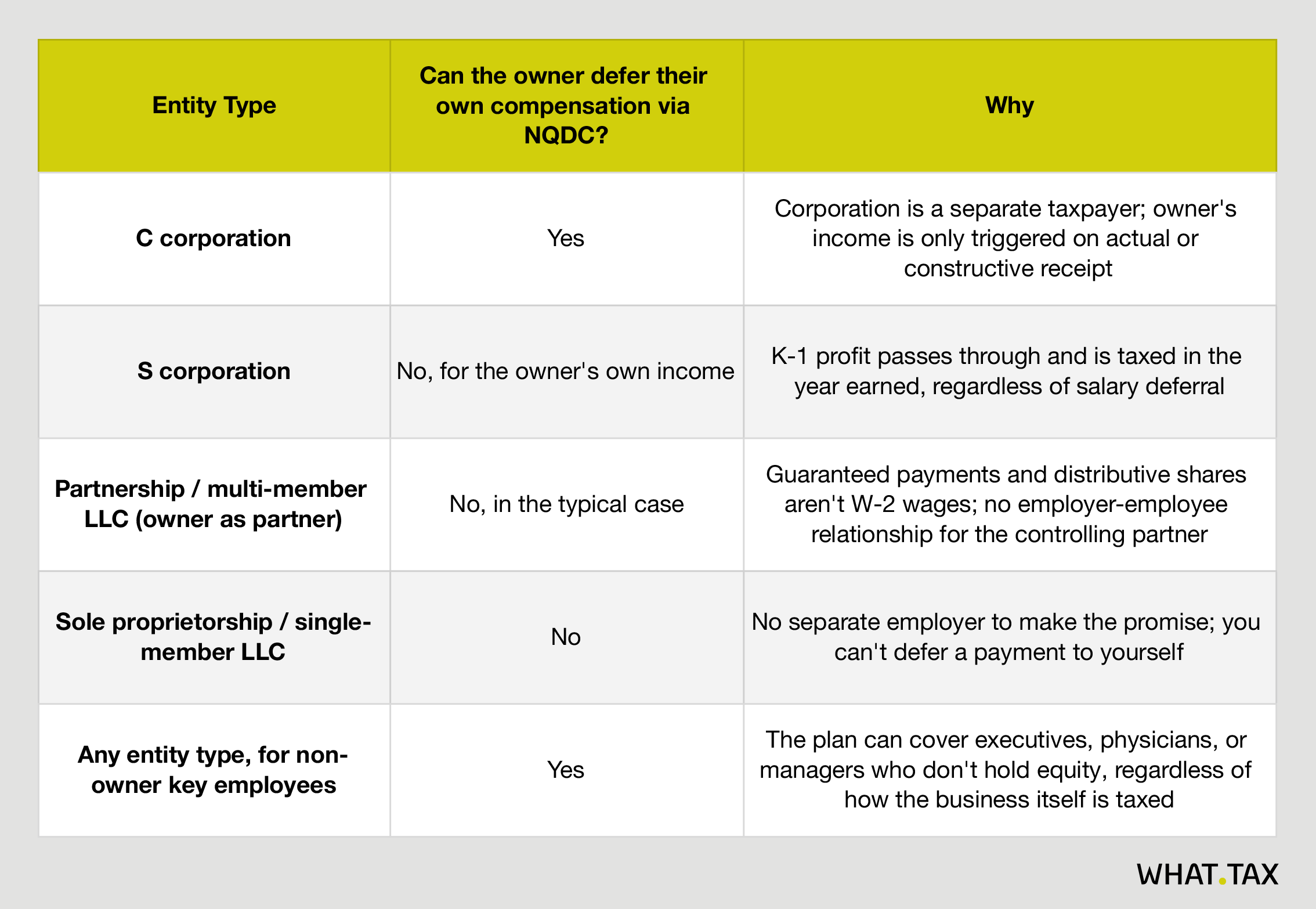
This doesn’t mean S corp owners and partners are locked out of every version of this strategy. You can still build a plan that benefits a non-owner CFO, a key salesperson, or a physician partner who isn’t a controlling owner. What you can’t do is defer your own K-1 income by simply not paying yourself a salary this year. If your entity is an S corp and you want the owner-level version of this strategy, the conversation to have with your CPA is whether a C corp subsidiary, a holding company structure, or a different comp arrangement makes sense, not whether your current S corp can accommodate a deferral election. It can’t.
