

Stop Waiting to Restructure Your Business. The Perfect Moment Doesn’t Exist.
Every quarter of hesitation has a price. Some of what you lose while waiting can never be recovered.


Ask ten business owners why they haven’t elected S-Corp status, split their business into separate entities, or opened a retirement plan, and eight will give you a timeline instead of a reason. Once things settle down. After this next contract closes. When revenue looks more predictable.
None of that is a plan. It’s a description of a moment that isn’t coming, dressed up as strategy.
I understand the instinct. Restructuring feels like it deserves a running start: stable numbers, a slow week, a mental green light.
But the tax code was not built around your readiness. It runs on fixed windows, fixed rates, and calendar math that doesn’t pause because you’re still deliberating. Some of what you forfeit by waiting gets deferred to next year. Some of it is simply gone, permanently, the moment the window closes.
Knowing which is which changes how urgently you should be moving.
Everything in this article is the foundation.
The Premium Newsletter is where it gets specific — the strategies your CPA probably hasn’t mentioned, the structures that protect what you’ve built, and the moves that are only worth making if you implement them correctly. Built for entrepreneurs who are done leaving money on the table.One implemented idea covers the subscription cost. Many times over.
The clock the IRS keeps runs whether you’re ready or not
Start with the mechanism most owners already half-understand: self-employment tax. Every dollar of net profit from a sole proprietorship or a default single-member LLC is subject to 15.3% in SE tax, split between the Social Security and Medicare portions, before a single dollar of federal income tax applies.
There’s no threshold you need to clear, no revenue you need to prove, no season you need to wait out. It accrues on the profit you’ve already earned, right now, this quarter.
Here’s what that looks like on a business clearing $150,000 in net profit, a range that covers a large share of consultants, single-operator agencies, and specialized trades:
Default sole-prop or LLC taxation: SE tax bill of roughly $21,194, using 2026 rates and the $184,500 Social Security wage base.
S-Corp election, 45% salary ratio: a defensible salary of $67,500 with the remaining $82,500 taken as a distribution. Combined employer-employee payroll tax on the salary portion drops to about $10,328. The distribution owes no SE tax and no payroll tax at all.
The gap: roughly $10,867 a year, or about $2,717 every quarter you don’t act.
Here’s the part owners consistently underweight: that money isn’t deferred. It isn’t sitting somewhere waiting to be claimed retroactively once you finally file the paperwork.
Every quarter that passes under default taxation is a quarter of SE tax paid in full, permanently, with no mechanism to go back and reclaim it once the year closes.
The chart below shows what that looks like compounding, not as an abstract percentage but as dollars that don’t come back.
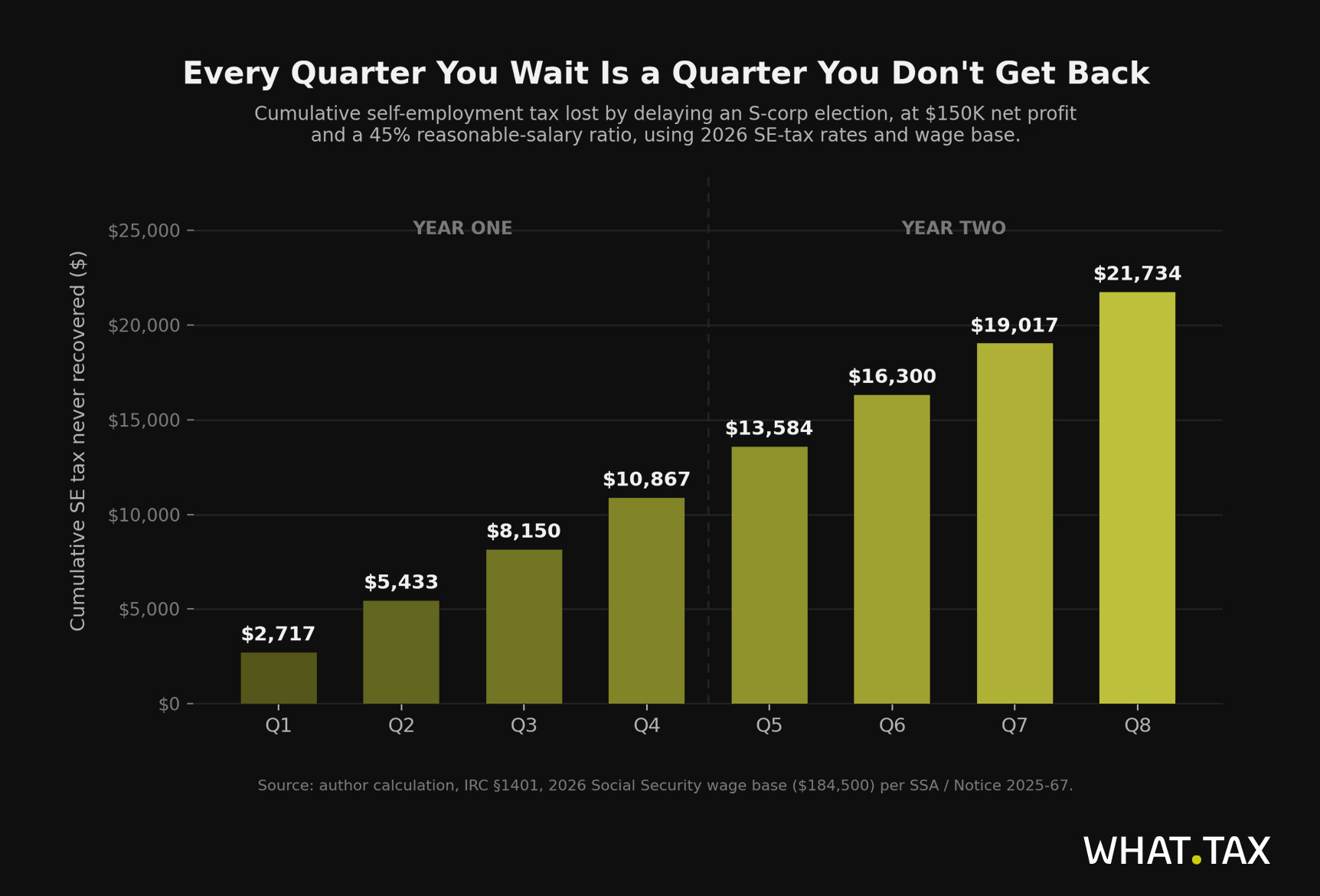
Two years of hesitation on a $ 150,000-profit business cost over $21,000 that a properly timed election would have kept in the owner’s pocket.
That’s not a rounding error. That’s a hire, a marketing budget, or a meaningful chunk of a retirement contribution, spent instead on tax you didn’t have to owe.

January 1 isn’t a deadline. It’s a habit you never examined.
The single most common reason I hear for delaying an S-Corp election is some version of “I’ll do it at the start of next year, so the books are clean.” This is where the actual mechanics diverge sharply from the folk wisdom.
Under IRC §1362(b)(3), an existing calendar-year business can file Form 2553 any time up to two months and fifteen days into the tax year (March 15 for most filers) and have the election apply retroactively to January 1 of that same year.
You don’t need a fresh calendar year to get a clean start. You need a signature and a two-page form filed before mid-March, and the entire year behaves as if the election had been in place from day one.
Miss that window, and the story doesn’t end. Rev. Proc. 2013-30 gives the IRS authority to grant late-election relief, but only within specific limits:
Filed within three years and seventy-five days of the intended effective date.
The entity and every shareholder must have reported income consistently with S-Corp treatment throughout.
The business must show documented reasonable cause for the delay, not just an oversight.
This relief works more often than most owners assume. It is not, however, automatic, and it is not free of consequence: back payroll filings, corrected returns, and often a CPA’s time to build a defensible, reasonable-cause narrative.
Beyond that three-year-and-change window, your only path is a private letter ruling from IRS Chief Counsel, a formal request that runs $3,500 to $28,000 or more in user fees alone, with no guarantee of approval. IRS Chief Counsel has denied these requests outright when a taxpayer couldn’t establish reasonable cause for the original delay.
The failure to timely elect S-Corp status, without a documented, defensible reason for it, is not a paperwork problem the IRS is obligated to fix for you.
That’s the real lesson buried in the late-election relief rules. The IRS built in flexibility because it understands that businesses don’t always follow a calendar-year schedule.
It did not build in a rescue plan for owners who simply never got around to it. Treating relief provisions as a backup plan, rather than fixing the timing upfront, is a bet against your own follow-through.

Retirement contribution room doesn’t roll over
Here’s where “I’ll wait” stops costing you money you’ll eventually recoup, and starts costing you money that’s gone for good.
Contribution room for a Solo 401(k) or SEP-IRA is a use-it-or-lose-it allowance tied to a specific tax year. For 2026, that room breaks down like this:
Employee deferral: up to $24,500, for owners under 50.
Employer profit-sharing: up to 25% of W-2 compensation for an S-Corp, or roughly 20% of net self-employment income for a sole proprietor.
Combined ceiling: $72,000, employee and employer contributions together.
Catch-up, ages 50–59 or 64+: an additional $8,000.
Catch-up, ages 60–63: an enhanced $11,250 under SECURE 2.0.
None of that room carries forward. If you don’t have a plan established and funded by the relevant deadline for a given tax year, that year’s contribution ceiling simply disappears.
Unlike an IRA, where at least the account exists year to year, even if you underfund it, a Solo 401(k) that doesn’t exist yet means the entire year’s employer and employee contribution capacity is unrecoverable, permanently, the moment the deadline passes.
The part that should actually change your behavior is what a single missed year costs by the time you retire, not this year, but decades from now. A one-time $30,000 employer contribution, invested and left to compound at a conservative 7% annually, yields a materially different amount depending solely on how many years it has to grow.
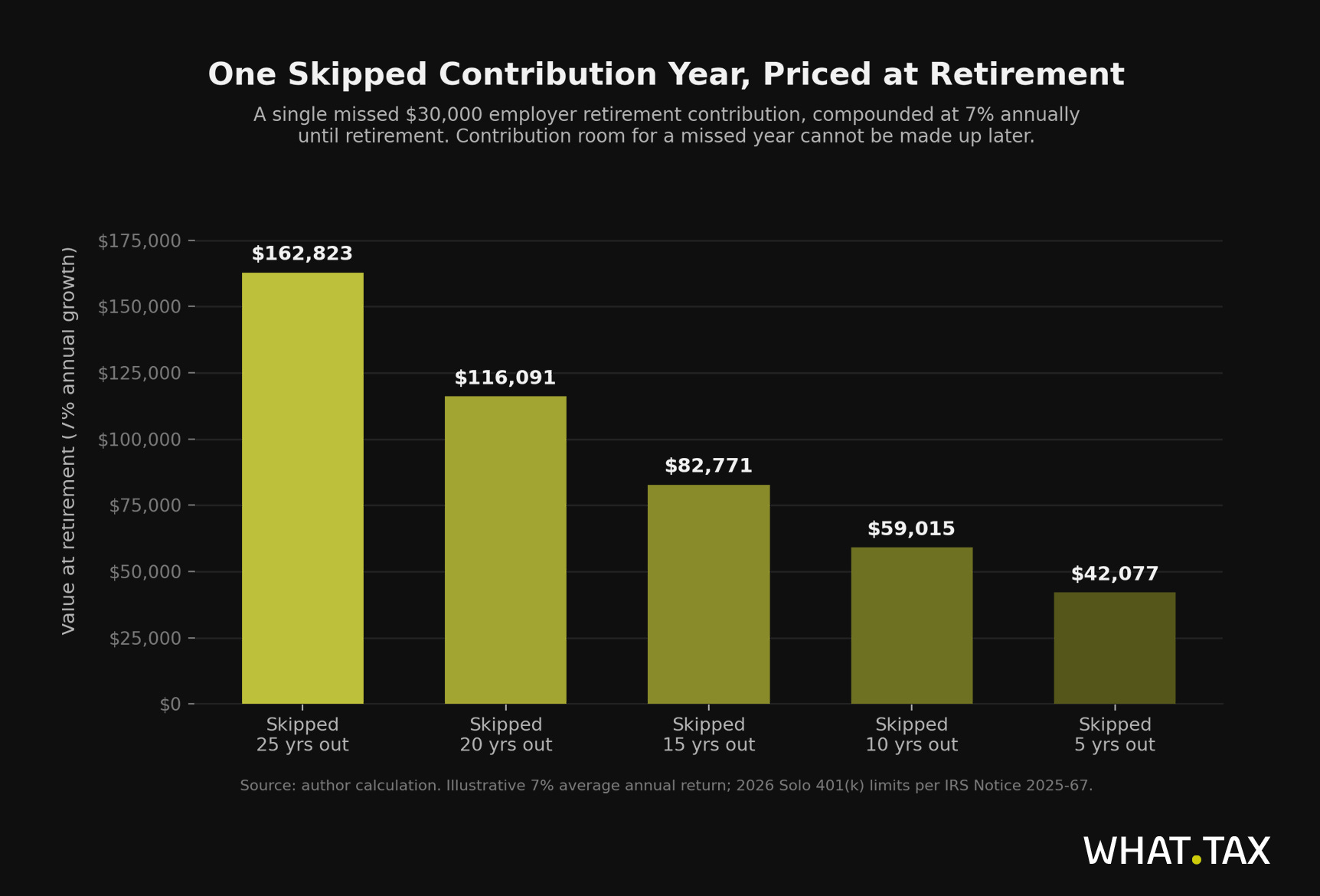
Skip that contribution 25 years before retirement, and you’ve given up roughly $163,000 at retirement. Skip the identical contribution just 5 years out, and the cost is a comparatively modest $42,000.
The lesson isn’t “retirement planning matters,” which you already know. It’s that the cost of waiting is front-loaded. The earlier in your career you delay setting up a plan, the more expensive every skipped year becomes, because compounding has more runway to work against you.
Owners in their 30s and 40s who tell themselves they’ll “get serious about retirement once the business is bigger” are making the single costliest version of this mistake, precisely because they’re doing it at the point where delay is most expensive.

The exclusion clock only starts when you actually start it
If your business has any plausible path toward a future sale, whether that’s an acquisition, a recapitalization, or eventually selling equity to outside investors, there’s a structural reason to stop waiting that has nothing to do with SE tax or retirement math.
Qualified Small Business Stock (Section 1202) lets shareholders in eligible C corporations exclude gain on the sale of that stock from federal income tax. The One Big Beautiful Bill Act, signed July 4, 2025, made the benefit considerably more accessible. For stock issued after that date:
50% exclusion for stock held at least three years.
75% exclusion for stock held at least four years.
100% exclusion for stock held at least five years.
Per-issuer cap raised from $10 million to $15 million.
Aggregate gross-assets eligibility threshold raised from $50 million to $75 million.
Here’s the piece that matters for the “waiting” argument specifically: the clock starts when qualifying stock is issued, not when you decide you’re ready to think about an exit.
If you’re currently operating as an LLC or an S-Corp and any part of your long-term plan involves converting to a C-Corp structure to access this exclusion, every year you delay that conversion is a year added, one for one, to the earliest date you become eligible for any exclusion at all. There is no retroactive version of this benefit.
A business that converts today starts counting years toward the three-year, 50% threshold. A business that waits three more years to “figure out the right structure” starts that same clock three years later than it had to, and the eventual sale, whenever it happens, walks straight into a smaller exclusion or none at all if the holding period hasn’t been met.
This is exactly why startup attorneys and venture-backed founders treat early C-Corp formation as a default rather than a someday decision. It isn’t about wanting corporate formality sooner. It’s about not paying, years later, for a clock that was free to start and expensive to have skipped.

Protection you haven’t built yet doesn’t protect you yet
There’s a fourth cost to waiting that has nothing to do with the IRS at all, and it’s the one most likely to catch an owner completely off guard: liability protection is prospective, not retroactive.
Say you’re operating without a formal entity, or with a single entity holding every asset and every contract you sign. Something goes wrong: a client dispute, a contractor injury, a defective product claim. If it happens before you’ve split things apart or formalized the structure, restructuring afterward does not reach back in time to shield you from that specific claim.
The liability shield an LLC, holding company, or multi-entity structure provides attaches from the point the structure exists forward. It has no power over what has already happened.
Owners who tell themselves they’ll “build out the holding company structure once there’s more to protect” have the logic backward. The moment there’s meaningfully more to protect is exactly the moment the risk of a claim against it also rises. By then, whatever happens between now and the day you actually finish the restructuring is happening on the exposed version of your business, not the protected one.
What a year of waiting actually costs, by lever
None of these four costs behave the same way, and that distinction should shape how you prioritize fixing them.
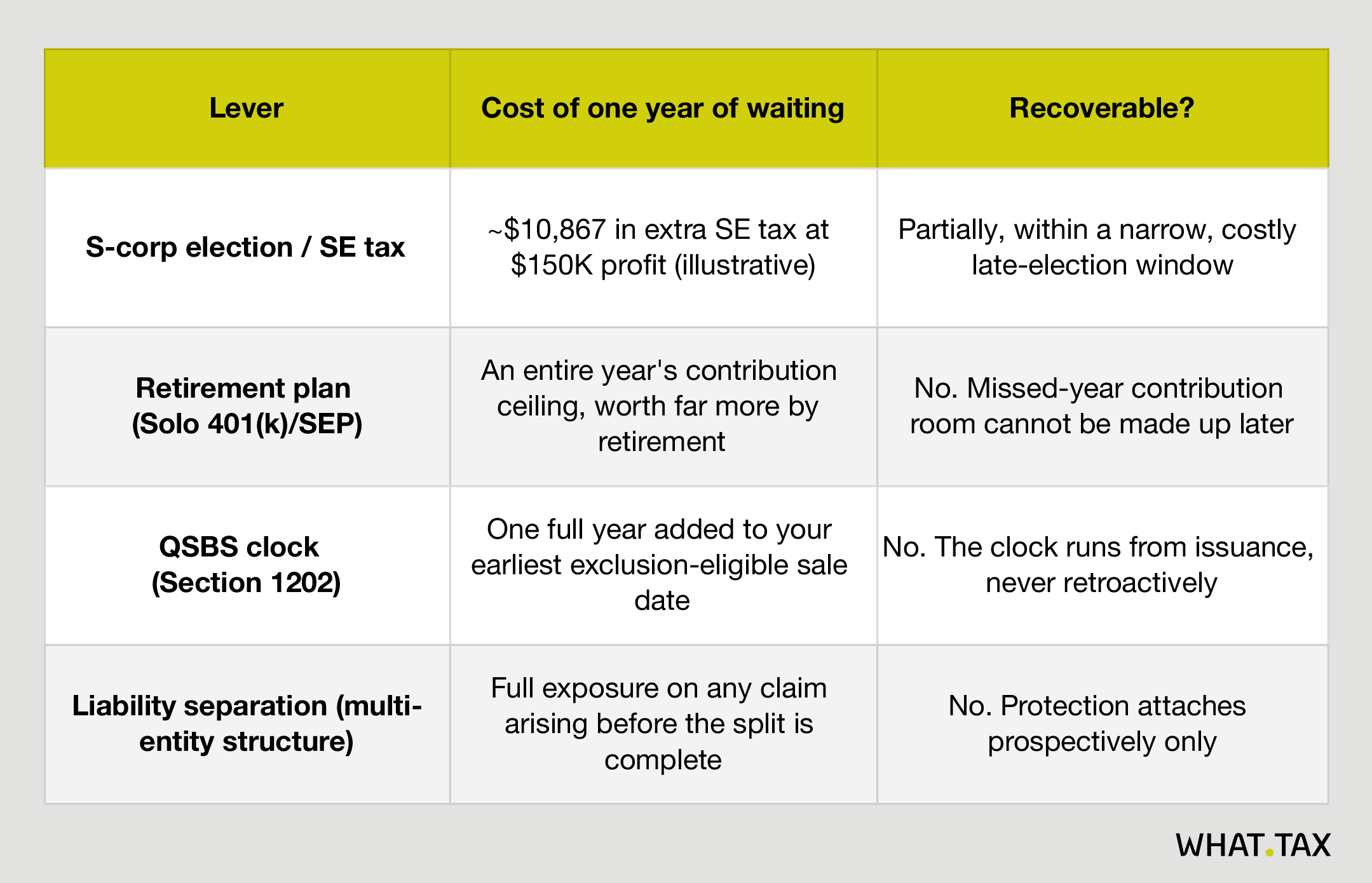
Two of these four are, at least partially, fixable after the fact if you catch them soon enough. Two of them are not fixable at all, ever, once a year has passed. That asymmetry is the entire argument for acting now rather than “eventually.”
When waiting is actually the right call
None of this means restructure on impulse. There are legitimate reasons to hold off, and a sharp owner should be able to tell the difference between strategic patience and avoidance dressed up as patience.
Profit hasn’t cleared the breakeven range. Below roughly $40,000 to $50,000 in net profit, the payroll administration and tax-prep overhead of an S-Corp typically outweighs the SE tax savings. Below that line, waiting isn’t procrastination, it’s math.
Revenue is genuinely unstable, not just uncertain. A single client representing the bulk of your income, with a real risk of walking away, makes committing to a fixed payroll obligation a cash-flow risk worth taking seriously before you lock it in.
A sale or major transaction is realistically weeks away. Restructuring mid-transaction adds friction and cost to a deal, rendering the new structure moot almost immediately.
You’re in an active dispute or audit. Changing entity structure while the IRS or a counterparty is actively scrutinizing your business can complicate matters that are better resolved first.
If none of those apply to you, and you’re still telling yourself you’ll get to it “once things calm down,” you’re not being cautious. You’re paying a quarterly fee to avoid a two-page form.

The moment you’re waiting for isn’t coming
There is no version of your business that feels perfectly ready to restructure. Revenue will always feel slightly too unpredictable, the timing will always feel slightly off, and there will always be a more urgent fire to put out first.
That feeling isn’t a signal. It’s just what running a business feels like, permanently.
The tax code doesn’t ask whether you feel ready. It asks whether the paperwork was filed on time. Every quarter you spend waiting for certainty that isn’t coming is:
A quarter of the self-employment tax you’ll never recoup.
A smaller and smaller window for late-election relief.
A year of retirement contribution room that vanished the day the deadline passed.
A QSBS clock that hasn’t started.
Liability exposure on a version of your business you were planning to protect eventually.
Eventually, it has a price. Most owners never bother to calculate it. Now you have.
This article is for educational purposes and doesn’t constitute tax or legal advice. Run your specific numbers past a qualified CPA before filing anything.
If you get value from this newsletter, please consider liking this post. It makes a significant impact and helps this work reach more entrepreneurs.
Thank you for your support.